New York City Subway
New York Subway Style Wall, 1973 by Richard Mirando
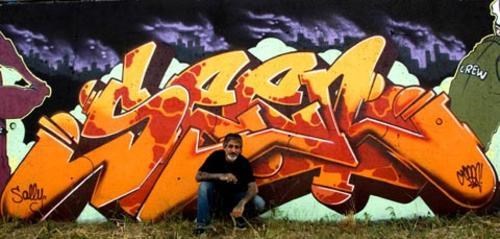
Personally, this graffiti reminds me a lot of an explosion of some kind. It is super bright and energetic in color, and the bright/pale yellow surrounded by all the fiery colors reminds me of a cartoon-like explosion or even a flame. It is very in your face and noticeable, which I think with the “SEEN” lettering makes a lot of sense; it's also done in Wildstyle, which makes it more sharp and chaotic. This graffiti in specific has some very interesting shapes and overlaps used on it which makes the letters a little harder to read, but again, it being so bright and noticeable yet hard to see while being the word seen could be part of the appeal.
Culturally, this graffiti is usually a more rebellious style of art. It could even be seen as a way to resist authority. Graffiti in the media is usually associated with more urban areas and is a source of the city's culture, as it gives the city some kind of identity since it is a way to give the people in urban settings a voice. Those who do graffiti (like Wildstyle, like this one) often have an ideology of thinking outside the box and defying norms.
Graffiti is done with spray paint, and it has to be done in different layers. People who do graffiti need to be good with solid shapes since the line work that separates the lettering is usually done last. These are also mostly done in more 3D styles, meaning the shading and highlights of colors also matter, and are done with something with less control than a brush, which could cause random splattering or uneven coats if the can isn't right. Another technicality with graffiti could be getting caught, since it is often done in areas where it is illegal, circling back to why this style is usually used as a form of rebellion.
The creator of the scene is referred to as the Godfather of Graffiti. “Seen” inspired a new style of graffiti for people to build and create new forms of graffiti. Graffiti was also seen as something more underground until Seen had a PBS documentary, which helped Graffiti become more mainstream.
The Godfather of Graffiti
Seen isn't like some other graffiti since Graffiti usually has some ethical or legal discussions about where it could be placed. For Seen, itwasn'tt only train cars; the creator also worked on canvases and cars, and was seen more as an artist, even exhibiting his works in Europe.
The design seen would be considered the “Wildstyle” of Graffiti. Due to the complexity of the words, it's also a bit hard to read, which is more wildstyle as part of the style. Wildstyle is also considered one of the hardest forms of graffiti, using curves and 3D design to make it stand out and make a statement. Seen includes elements like Co, rast, using the brighter, fiery colors to contrast the dark grey colors in the background.
Growing up, I always considered Graffiti to be something “trashy” or something that made cities more cluttered, which, admit it now, was a childish and immature way of processing the art that it really was. It takes a lot of skill to create something that complex. As I got older, I found myself admiring the graffiti in urban areas; the control and knowledge you need to have for the shapes is so unique and eye-catching. Some time last year, I actually tried to replicate some of the styles I saw. With that attempt, I was humbled very quickly and gained an appreciation for graffiti at the same time.